

Living Workshop
The Basis of Frequency and Music
What is a "note" in music?
Musical notes are not some magical thing, they are simply frequencies being played in various ways. For example, a piano creates notes by hitting a set of, usually, 3 strings at the same time with a padded hammer. Trumpet players create a buzzing noise with their mouths at a certain frequency and the trumpet amplifies that to the sound we recognize. A guitar works similarly to a piano, where notes are created by plucking the string and putting a finger at certain points to change the length of the string.
Understanding guitar strings and frequencies will require a quick dive into physics, though we won't go too deep.
How do guitar strings even produce a frequency?
When a taut string is clamped at both ends and energy is introduced through something like plucking the string, waves are formed on the string. Guitar strings will produce waves based upon their length and gauge (or diameter). These waves will have multiple different frequencies, the most basic of which is the fundamental frequency. The fundamental frequency is the one where the wavelength is twice the length of the string. It can be visualized like so:
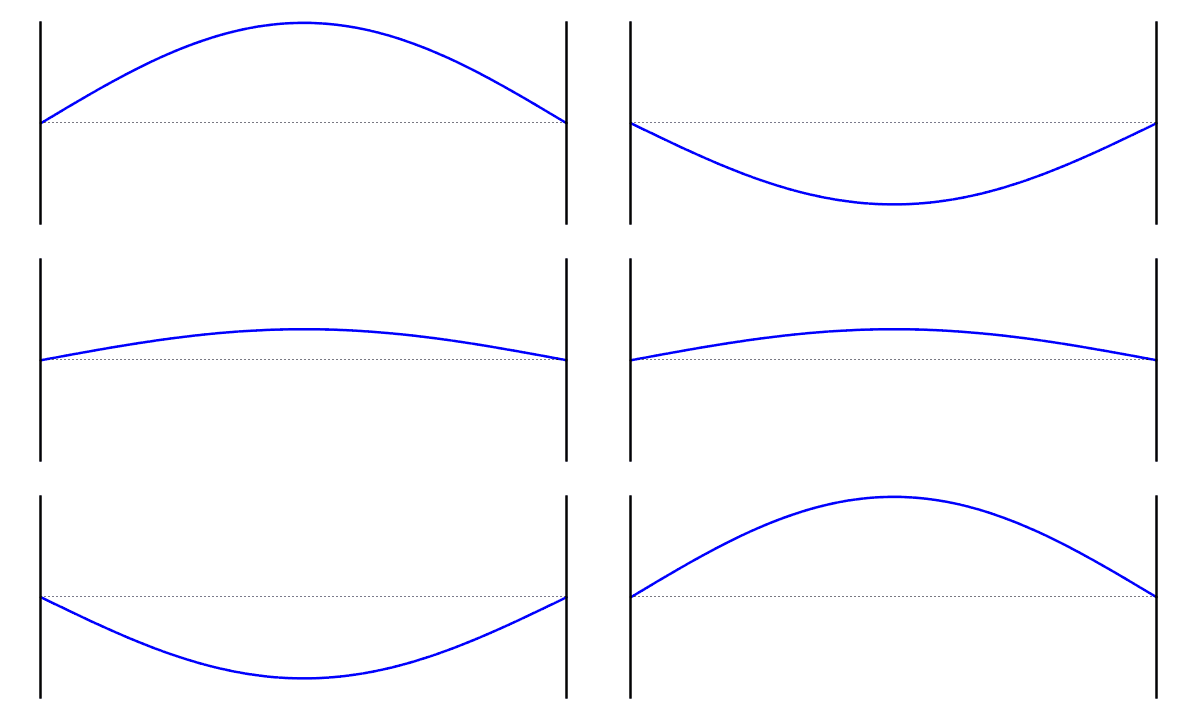
Note that this is (an exaggerated) displacement of the physical string itself versus time. This fundamental frequency is what we mostly hear when a guitar string, or similar strings, are played. This fundamental frequency can be determined by the formula:

Where is gauge in this formula? It's a mix between mass and a bit of tension. Without going too deep, as string gauge goes up (diameter increases), the combination of mass and tension changes such that frequency goes down. This is why there are six different frequencies for the six standard strings on a guitar: each string has a certain gauge and this determines the fundamental frequency (82 Hz, 110 Hz, 147 Hz, 196 Hz, 247 Hz, and 330 Hz roughly, for the lowE, A, D, G, B, and highE respectively). Notice that length does not go down between the 6 strings on a guitar. We'll get to this later.
We mentioned earlier that the fundamental frequency is most of what you hear, so what's the rest? That's where harmonics become relevant. The actual wave on a string is made up of more than just the wave creating the fundamental frequency (we can see the actual wave later in this workshop. It looks much more complex than just a single wave in a "jump rope" pattern). If you've taken a physics class before, you've probably seen an image like this:
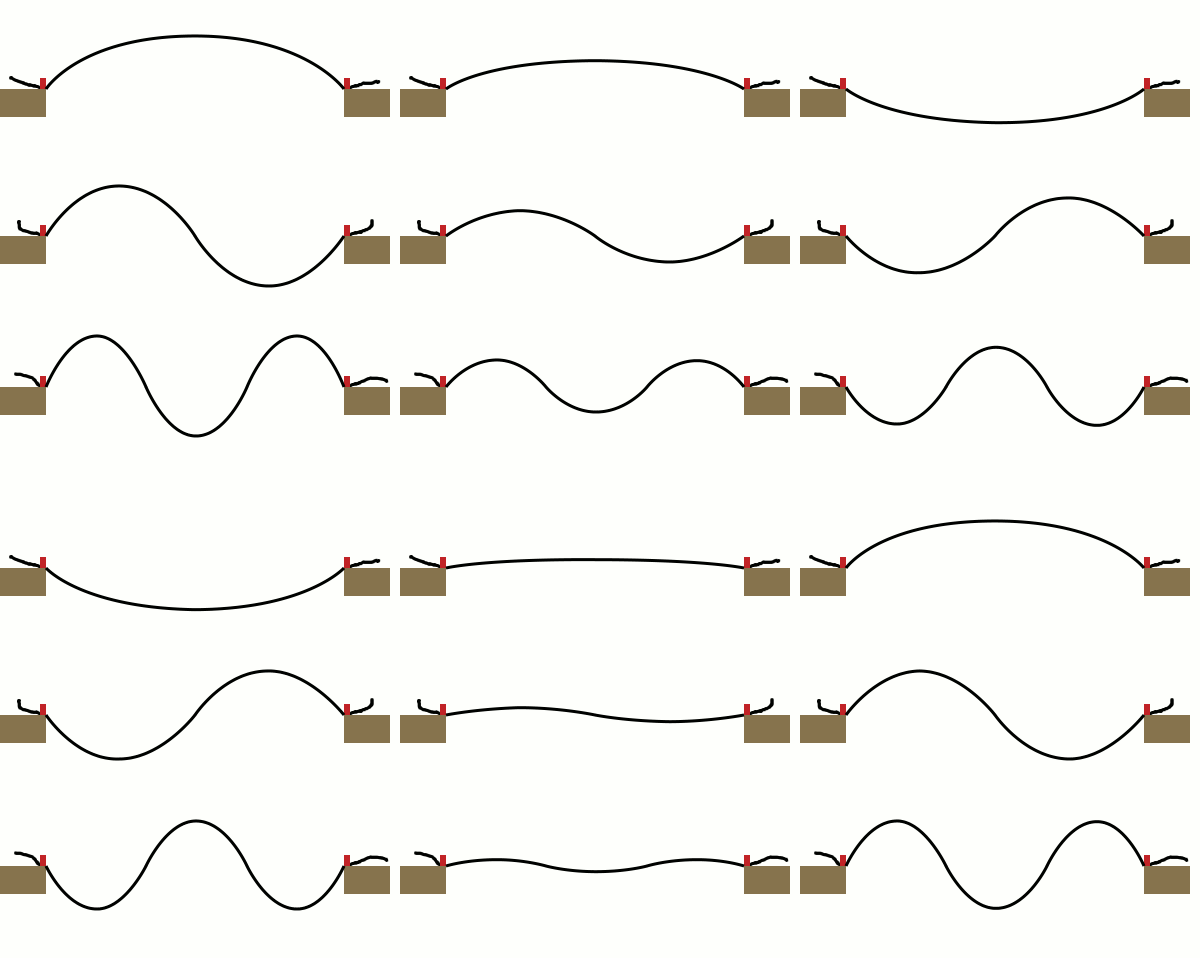
Above, we see the fundamental frequency as well as two other frequencies. These are harmonics, specifically the second and third harmonic. When a string like the one shown (taut and clamped at both ends like a guitar string) is excited with some energy, "nodes" are created throughout the length of the string at evenly spaced points. Take the second harmonic (middle string in above gif) for example. One node is placed at the middle of the string, exactly halfway between the endpoints, and the string oscillates around that point. What's the frequency of this harmonic? It's not the same as the fundamental frequency. Harmonic frequencies are integer multiples of the fundamental frequency, so the second harmonic's frequency is twice the fundamental, the third is three times the fundamental, etc. Do we actually hear these harmonics? Somewhat, though they diminish in strength as the harmonic number increases. Typically, the second and third harmonic are the only ones strong enough to be considered relevant in terms of sound.
Guitar strings can produce frequencies based on the properties of the string. How do we make different notes?
In order to make music on a guitar, we need a little more than just the six basic notes given to us with the six strings. Earlier, we said that the length of the strings on a guitar (between the clamping points) does not change. This is where we make new frequencies, therefore making new notes.
Putting your finger on the fret of a guitar doesn't change the properties of the string itself, but it does change the length being considered. The length of string between a player's fingers and the main body of the guitar is what's considered, as this is where the acoustic amplification takes place in acoustic guitars, and it's where the pickups are located in electrical guitars. Going back to the formula:

Placing a finger on a fret of a guitar clamps that end of the string to that fret, thus shortening the length of the string being considered. Shortening the length of a string following the above formula means the fundamental frequency being produced (as well as the harmonics) is now higher. This higher frequency is now a new note.
Here are some notes and their corresponding frequency graphs (all done using Audacity, since Audacity will also show us the note being played in their Frequency Analysis Tool. Pay attention to the "peak" value):


The graphs above show 'strength' of sound in dB versus frequency, meaning the higher the graph at a particular frequency, the more prevalent that frequency is to the signal. This is an FFT (Fast Fourier Transform) Tool, which can break down an incoming signal into its frequency components by magnitude. How it works is beyond the scope of this workshop, but its output is easily understandable. As we can see, the highest peak (the fundamental frequency) is at 162 Hz, which matches the expected frequency from the note played (this is one octave above lowE, so we expect twice that note's frequency, or 164 Hz. We'll expand more on octaves later). This note is created by placing the finger on the 12th fret of the lowE string, which is halfway between both ends of the string. Here, we can also see the harmonics, which correspond to the peaks at higher frequencies. The second harmonic of our played note is also shown at 323 Hz, which is double the fundamental as expected. The third is at 494 Hz, roughly 3 times the fundamental. We can also see that the harmonics generally decrease in strength as the harmonic number increases. If you pay very close attention to the sound bite of the Mid E, you can also hear some of the harmonics as well (they will also sound like an E, but one or two octaves higher), though most of the sound is dominated by the main, 162 Hz sound.


Here, we play a C, which is played on the 5th fret of the G, or third, string. Equally, it could be played on the first fret of the B string or the 10th fret of the D string. The fundamental frequency is higher than that of G (196 Hz), which is to be expected seeing as we are shortening the length of that string by placing our fingers on a fret. The fundamental frequency is found to be 267 Hz with a second harmonic at 527 Hz, roughly as expected. This example also shows that there are many harmonics that make up even a single note, as each peak roughly translates to another harmonic, noting the logarithmic scale for frequency (some peaks are do to outside noise captured during the recording process).
What if multiple notes are played at once?
Music, as most would know, is more than just single notes at a time. A chord is when 3 notes are played at once, typically being made up of a third (3 full notes from a reference note) and a fifth (5 full notes from a reference note). Many chords exist such as major, minor, diminished, augmented, etc. but for the purposes of this workshop, we'll analyze the basic C major chord, made up of C, E, and G. I'll play C4 (267 Hz from earlier), E4 (or highE, 330 Hz), and G4 (about 395 Hz).
Analyzing the individual notes, we can see their fundamental frequencies:


Played separately at first, these are the frequency readings from those 3 notes. Notice that the frequencies match very nicely to the expected values for these notes. When played together, we get an interesting, though relatively straightforward result.

We see a large "lump" of frequencies around the 250 to 400 Hz range. That's the combination of our C, E and G (267, 326, and 392 Hz) readings. The frequencies don't add together to become some higher, unique frequency, rather they combine to play all at the same time.
Some more advanced software to tie it all together!
Now that we're more familiar with audio signals and music, we can employ some more advanced software (friture) and look at the live frequency reading and waveform to see how they react to notes being played. Here's the same C major chord being played, but with a live reading.
Here we can see the 3 notes being played at the beginning of the clip and reading the correct frequencies in the frequency graphs. We also see a relatively stable wave in the 'scope' portion of the video. When all 3 notes are being played, the waveform starts jiggling, which is the combination of all 3 notes together to form a single, more complicated, wave. We can also see three spikes in the frequency graphs at the frequencies of our notes being played, even when all three are played at the same time.
We can also more easily see the difference between playing notes at different octaves in the live waveform reader. An octave above a certain note is defined as twice the frequency, one octave below is half the frequency. This also means the second harmonic of any note being played is one octave above the fundamental frequency being played. Here's two different G# notes being played, first a reference note, then the second an octave above. Notice how the frequency of the incoming signal in the 'scope' portion of the video clearly changes (the FFT portion confirms it nearly doubles!).
Lastly, let's look at one final (and fun) portion of our workshop: the waveform and FFT readings from the background music from our Video Demo. This waveform reading helps to show how many music pieces are centered around only a few notes, here those notes are the most prominent oscillations in the scope reading, and how other notes and bass beats are layered on top of them to generate a song. The FFT readings will also show the most prominent frequency being played at any specific time. Notice how many of these notes are within the range of the basic guitar strings as this is primarily a guitar based song.
Thank you for going through our workshop! Had this been in person, we would have had people download a mobile app for frequency reading and Audacity and/or Friture for their laptops (Audacity is much more popular). This would have allowed us to play some notes live and let people see how the waves are formed, how notes have their own set frequencies, and how the fundamental frequencies and harmonics show up, even though it's not what our ears usually focus on. However, since this workshop was to eventually be virtual, we thought it would be better to just include the sound bits and some photos and videos with the software so everyone could view it, regardless of where they are. We hope this helped to understand more about the basics of music on stringed instruments and how they tie into frequency readings!